
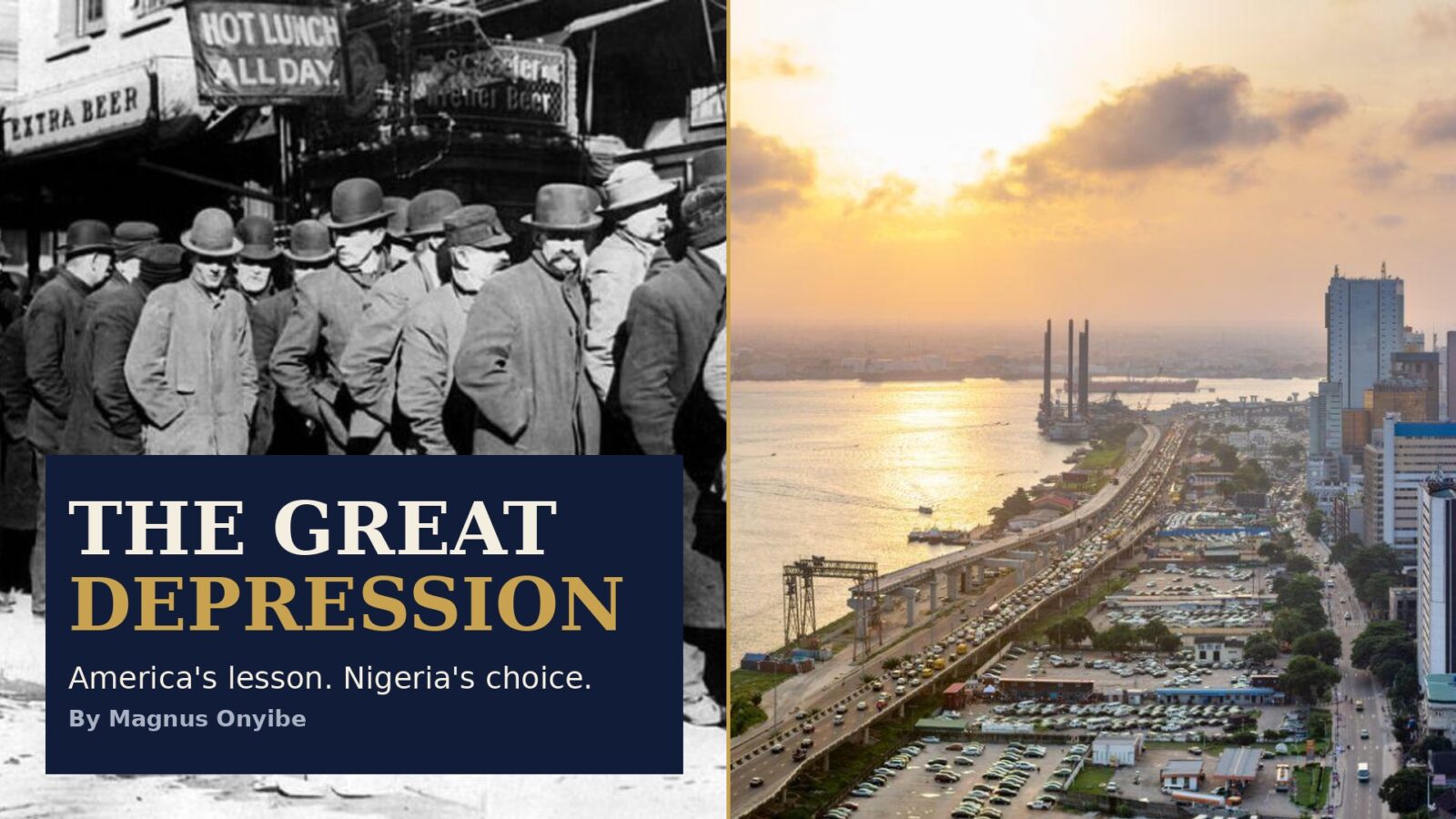
To put the current situation in Nigeria into context, it is worth recalling that, owing to the bold and sweeping reform measures embarked upon by President Bola Ahmed Tinubu since he assumed office on May 29, 2023, a significant number of Nigerians (133 million, according to the latest NBS estimate) are believed to have been pushed into heightened levels of economic hardship.
This has inspired me to draw a comparison between Nigeria’s current situation and the Great Depression of the 1930s in the United States of America (USA).
The justification for this comparison is that Nigeria’s presidential-style democracy was borrowed from the USA in 1979. Coincidentally, a general election is scheduled to hold in Nigeria on January 16, 2027, to elect the president and members of the National Assembly, while the governorship and state Assembly elections are scheduled for February 6.
Strikingly, these elections will take place at a time when most Nigerians are experiencing severe costof-living challenges, which I have compared to the Great Depression experienced in the US from 1929.
The prevailing hardship is principally attributable to President Tinubu’s termination of the nearly five-decade-old petrol subsidy policy, which was gulping about N4 trillion annually and had apparently become unsustainable, as the government was borrowing to pay civil servants’ salaries and meet its other obligations.
As such, there is general agreement among leaders of both the ruling and opposition parties that our country was tottering on the brink of collapse and could have become a failed state had President Tinubu not introduced the policies of ending petrol subsidies and unifying the multiple naira exchange-rate windows.
The snag, however, has been the difference of opinion between the ruling and opposition party leaders over how the removal of the petrol subsidy could have been implemented.
Whereas the incumbent administration of President Tinubu has, in its nearly four years at the helm of affairs, adopted the shock-therapy approach by abruptly ending the subsidy regime, some opposition leaders had initially contended that they could have adopted a gradual approach.
Perhaps capitalising on the hard times triggered by the reforms, one of the presidential candidates of a major opposition party has, in an interesting twist, reversed his earlier position, declaring that he would restore petrol subsidies if elected President in 2027.
Given the pivotal role petrol plays in facilitating transportation, which is a major driver of economic activity, and indeed all human endeavors, particularly in a developing nation such as ours, the withdrawal of the petrol subsidy, which has significantly increased fuel costs, has had dire consequences for long-suffering Nigerians, who are bearing the evidently unintended pains of the reforms.
Consequently, the current high cost of living has become a critical factor in determining whether the ruling All Progressives Congress (APC) will be re-elected or whether its formidable challengers, such as the African Democratic Congress (ADC), with former Vice President Atiku Abubakar as its presidential candidate, and the National Democratic Congress (NDC), with Peter Obi, the former Labour Party’s presidential flagbearer in 2023, as its standard-bearer, will replace the APC in the Aso Rock Presidential Villa, the seat of power, in 2027.
However, the Tinubu reforms are not all about gloom and doom, as they have yielded some positive outcomes. The gains, though, have manifested mainly at the macroeconomic level, where large corporations, including banks, fintechs, oil and gas companies, and telecommunications firms, are recording huge profits running into trillions of naira, as some of Nigeria’s hitherto dismal fundamental economic indicators have improved significantly.
In our country, owing to the uneven structure of income distribution in society, the macroeconomy and those currently reaping the benefits of the reforms represent, more or less, just 1–2% of Nigeria’s population.
Consequently, there has been no corresponding improvement at the microeconomic level, where small and medium-sized enterprises (SMEs) thrive and where the masses, if you like, 98–99% of Nigerians, are concentrated.
Unsurprisingly, Nigerians, especially those at the bottom of the economic pyramid, are despondent and crestfallen, owing to the delay in prosperity at the macroeconomic level filtering down to the microeconomic level.
The lengthy process of prosperity trickling down from the rich to the poor quickly enough to prevent the hoi polloi from becoming too anxious and eventually irrational is a fundamental issue that economic development experts have grappled with but have yet to find a quick fix for.
The scenario outlined above represents the dilemma that Nigeria, as a nation, is currently grappling with. While the administration is telling the masses that there is light at the end of the tunnel, the masses are losing patience and becoming increasingly anxious because their lived reality is different.
The danger of such a mindset is that actions driven by anxiety often turn out to be irrational.
Therefore, the situation described above should be a source of concern to the ruling APC, particularly at this vulnerable time, when we are less than seventy (70) days away from January 16, 2027, when Nigerians will cast their ballots.
As a supporter of the massive reforms embarked upon by President Tinubu since his ascension to the Aso Rock Presidential Villa on May 29, 2023, I share the enthusiasm that the fundamentals of the Nigerian economy have undergone a massive reset and that our country has become more viable and buoyant.
This is evidenced by its current robust for eign exchange reserves, trending at $55 billion; Gross Domestic Product (GDP) growth of 4.6%; crude oil production stabilising at about 1.6 million barrels per day; and a steady flow of foreign investments into our country.
In light of the reality outlined above, it is disturbing that opposition parties appear to be overwhelming Nigerians, particularly voters at the microeconomic level, with a narrative of doom and gloom about the nation, which does not tell the whole story.
They seem to be succeeding in doing so, while the ruling party has apparently failed to adequately explain its policies and programmes, including their positive outcomes, to the masses.
If more Nigerians were being carried along in a timely and effective manner, rather than being left to figure out the administration’s short- and long-term development plans for themselves, the situation might have been different.
For instance, the cocktail of policy measures announced, implemented or yet be implemented, mainly in October last month, as palliatives and short-term interventions against poverty, complements the administration’s long-term plans, which include massive ongoing investments in roads, such as the Lagos-Calabar Coastal Highway and the Badagry Expressway, bridges, housing estates, airports and seaports, as well as school infrastructure.
These projects are expected to create more jobs sooner rather than later.
Had these initiatives been effectively communicated to the public earlier, many Nigerians who appear to have lost hope for a better future at the moment might have had their hopes renewed.
This is particularly so if they were reminded of the horrors of queuing for days to purchase petrol, only to end up buying it on the black market, sometimes at exorbitant prices, compared with the situation today, when they can simply drive into petrol stations and purchase the commodity without hassles.
Similarly, reform sceptics might be compelled to ask themselves whether they would prefer a return to the dark days of persistent Academic Staff Union of Universities (ASUU) strikes, when universities were shut down for months and sometimes years.
Consequently, four-year degree programmes in Nigeria often stretched to seven years, compelling our youths to pursue university education in foreign countries, some of which had lower educational standards than ours before the decline in our educational system.
This contrasts sharply with the situation today, when the introduction of the Nigerian Education Loan Fund (NELFUND) has democratised access to university education.
Under this arrangement, any Nigerian who gains admission into a university no longer has to worry about whether their parents are rich or poor before pursuing their dream of obtaining a university degree or advancing their higher education.
Readers may be amazed at how ignorant Nigerian youths are about NELFUND even amongst university students. One wonders if student union bodies in our tertiary institutions who represent a powerful voting bloc have been co-opted into the student enlightement process by relevant agencies of government.
The reason for highlighting the socioeconomic challenges Nigerians are currently contending with, how we got into this quagmire, and what the Tinubu administration is doing about it is to establish a context and framework for comparing our situation with the grim and horrific experience that Americans conquered during the Great Depression before emerging as the most powerful and wealthiest nation in the world.
Two American leaders, Herbert Hoover and Franklin Delano Roosevelt (FDR), had the privilege of leading the United States back-to-back.
While one President presided over the country as it plunged into the infamous Great Depression, the other led the nation out of it through aggressive and bold policy interventions, which were initially painful but ultimately enabled the United States to extricate itself from the economic doldrums and emerge as arguably the most prosperous and industrialised nation in the world.
Now, I crave the indulgence of Nigerians to submit that, in 1929, America was in a position comparable to that of Nigeria in 2023.
That is because, in the United States of America (USA) at the time, Gross Domestic Product (GDP) was rising, stock markets were booming, and prosperity was palpable.
However, the top 0.1% of the population owned 34% of the country’s wealth, just as banks in Nigeria declared profits of N6.7 trillion in 2024 (beneficial owners are less than 1% of population) an unprecedented and humongous financial gain, while youth unemployment remained above 40%.
Then, during that period in the US, an economic crash occurred. What the leaders of government did to tackle the challenge determined whether 15 million people would remain unemployed or return to work.
President Herbert Hoover, who was in office from 1929 to 1933, was the equivalent of our leaders who opted to use palliatives to patch up an economy that was tanking and in turmoil.
That was Nigeria’s economic playbook before the advent of President Tinubu, and it is the approach some prospective leaders are promising to take us back to if elected. As may be recalled, President Herbert Hoover believed in subsidies.
This was reflected in his approach, which was not to increase taxes on corporations, in the hope that they would employ more people. However, they did not. Instead, they hoarded their wealth at the macroeconomic level, a situation that bears some resemblance to what is happening with the huge profits declared by Nigerian banks in 2024, which have yet to trickle down sufficiently to the wider population.
Hoover also appealed to businesses not to cut wages voluntarily, but they did so anyway.
He balanced the budget during the Depression by cutting federal spending by 10%, at a time when people needed government support the most. He also called for charity rather than job creation, selling Americans the notion that “prosperity is around the corner” without providing realistic and pragmatic pathways to achieving it.
According to historical accounts I unearthed in the course of a simple research exercise, which enabled me to draw parallels between the Great Depression in the US and Nigeria’s current hardship arising from ongoing reforms, the result of promoting consumption over three years was a 29% decline in GDP, an increase in unemployment from 3% to 25%, and the collapse of 9,000 banks. Consequently, the life savings of farmers were wiped out, while breadlines (food queues) stretched for two miles in New York.
The reason the Hoover approach failed was that he subsidised consumption at the top, hoping that the benefits would trickle down. This is similar to what Nigeria had been doing for over four decades by subsidising petrol pump prices at an estimated cost of N4 trillion annually. The policy disproportionately benefited the rich, who own big, petrol-guzzling SUVs, more than poor Nigerians, whose main means of mobility are commercial motorcycles (Okada) and tricycles (Keke) that use very little quantity of petrol.
An interesting revelation to me is that, statistically, for every $1 given to the rich, only $0.20 worth of demand is created because the wealthy tend to save rather than spend.That is according to Harvard university economists.
By adopting Hoover’s template, although Nigeria eventually ended petrol consumption subsidies and saved about N4 trillion annually, a good portion of the savings was used to service debt, which accounted for 43% of the budget, and fund Compressed Natural Gas (CNG) buses for about 2% of commuters as a preliminary palliative measure.
To tame inflation arising from the devaluation of the naira by over 100% the Central Bank of Nigeria (CBN) raised its interest rate to around 27.5%.
Consequently, the flow of credit was reversed, as funds increasingly went to the government instead of businesses, crowding out or stifling particularly the manufacturing sector , which is one of the biggest creators of jobs. In effect, money moved upwards, away from traders and businesses towards the government.
As a result, although GDP grew to 3.4% in the previousb years and has now risen to 4.6%, about 133 million Nigerians fell into poverty, according to the European Union (EU) Ambassador, Gautier Mignot, in a rather pointed remark.
This depiction of a macroeconomy that is improving while the microeconomy remains depressed is the paradox of the Nigerian economy that President Tinubu is currently grappling with. It could become a sort of albatross around his neck unless he acts as Roosevelt did to rescue America and position it as a global hegemon.
For proper context and to put things in clearer perspective, let us compare Hoover’s consumption-subsidy approach, which plunged the US deeper into the Great Depression, with the presidency of Franklin Delano Roosevelt (FDR), from 1933 to 1945, whose economic recovery programme was driven by production-oriented public investment and support for productive activity. This is the approach Nigeria needs now and is presumably reflected in President Tinubu’s current playbook, including his removal of petrol subsidies and introduction of NELFUND.
President Franklin Delano Roosevelt became President in March 1933 and broke with many established conventions, just as Tinubu appears to have done in Nigeria since May 29, 2023, when he was sworn into office.
During his first 100 days, FDR secured the passage of 15 major laws. His administration’s interventions were not simply consumption handouts; they included measures to stabilise the financial system, create employment, stimulate production and build national infrastructure.
President Tinubu appears to have adopted a similar path towards economic recovery in Nigeria by ending the over four-decade-old petrol subsidy regime, unifying the multiple foreign exchange windows, reforming the colonial-era tax policy, introducing a new Electricity Act that allows subnational governments and the private sector to lead investments in the electricity sector and the broader energy space, and addressing energy insecurity, which is one of the major obstacles to manufacturing and industrialisation in Nigeria.
He is also on course to decentralise the policing system, one of the key areas requiring reform to tackle the unacceptable level of insecurity threatening our country.
Records indicate that Roosevelt, through his Works Progress Administration (WPA), which can be likened to Nigeria’s NELFUND initiative and proposed massive investments in the production and deployment of Okada and Keke, directly employed 8.5 million Americans to build 650,000 miles of roads, 124,000 bridges, 125,000 schools and 8,000 parks.
Does Tinubu’s massive investment in road infrastructure, from Lagos to Calabar and Badagry to Sokoto, not remind readers of the extensive road development undertaken during Roosevelt’s administration?
(1) Every dollar invested generated both wages and physical assets.
Nigeria’s equivalent could be to use the N1.77 trillion petrol discount expenditure to fund the lease-to-own acquisition of 500,000 electric Keke and provide educational support through NELFUND to 2.5 million students.
2. The Tennessee Valley Authority (TVA) and Nigeria’s Solar Mini-Grids.
The Tennessee Valley Authority (TVA) can be likened to the solar mini-grid investments being advocated as a solution to the energy insecurity currently constraining our country from experiencing an industrial take-off.
Our nation still produces a mere 5,000 megawatts of electricity for a population estimated at over 230 million.
That is.far less than the elextricity that Dangote and Lekki Export Free Zone generate.
To reset America, Roosevelt provided subsidised electricity at three cents to some of the poorest communities in the Tennessee Valley, at an enormous cost of $1 billion at the time. However, that intervention helped create the foundation for factories and industrial development over the following decades.
Correspondingly, the Tinubu administration in Nigeria is writing off an estimated N7 trillion in debts owed to electricity generation companies (GENCOs) via issuance of bonds to clear part of the financial backlog and create the conditions for a more functional electricity sector.
Another equivalent would be the provision of solar mini-grids for markets and business clusters, rather than relying on fuel discounts or price modulation, which Finance Minister Taiwo Oyedele proposed in October as a panacea.
3. Social Security and Direct Cash Transfers.
FDR also introduced Social Security, a fiscal bridge that can be compared with the direct cash transfers to indigent Nigerians introduced by the Tinubu administration at the inception of its tenure.
The administration has increased the amount twice, from N15,000 to N25,000 and subsequently to the current N50,000.
Roosevelt was among the pioneers of government-backed financial support for the elderly and unemployed in American society. His Social Security programme was funded through payroll contributions, making it a revolving and sustainable system.
Hopefully, the revamped Ministry of Humanitarian Affairs, under the new minister, Dr.Bernard Doro, which has reportedly reached 15 million Nigerians, will take note of Roosevelt’s innovative approach in the 1930s.
The results of Roosevelt’s interventions were remarkable. By 1937, unemployment in the US, which had climbed to 25% under Hoover, had fallen to 14%.
Likewise, GDP had recovered to its 1929 level, while every $1 invested in the WPA reportedly generated $1.80 in GDP, producing a multiplier effect because the physical assets created remained in place and continued to contribute to economic activity.
The Math That Matters.
BMl, a Fitch subsidiary had, when it appeared that Nigeria was experimenting with a return to the subsidy regime, warned that the proposed N1.77 trillion petrol discount, which is essentially another form of consumption subsidy in a different guise, had a multiplier effect of just 0.3 times, left no productive assets behind and encouraged smuggling.
My counterproposal in my previous interventions in this column regarding petrol subsidy removal has been that the N1.77 trillion should not have been invested in petrol pump price discount and modulation instead of being deployed as a production subsidy.
That would produce 500,000 electric vehicles (EVs), comprising Keke and Okada, at N3.5 million each, creating 500,000 Keke ownership opportunities. It would also cut transportation costs by 60% for 20 million riders. Best of all, the transportation assets would last for about ten years.
It is doubtless that Nigeria’s reality right now is that we are at America’s 1932 moment.
After three years of Hoover-style economic management, GDP was growing, but household pots were empty. That is why according to SBM Intelligence, the cost of preparing one pot of jollof rice still accounts for 37% of the minimum wage.
We can either repeat Hoover’s economic management template by relying on consumption subsidies and spending N1.77 trillion on petrol discounts over six months, allowing the macroeconomic indicators to continue looking good without delivering meaningful benefits to ordinary Nigerians, or adopt the Roosevelt approach by converting every naira saved from consumption subsidies into production subsidies, such as NELFUND for education, electric Keke/Okada for a robust mass transportation system, and solar mini-grids for energy security.
From the historical narrative and records outlined above, America tried both approaches. One contributed to breadlines and hardship, while the other helped create the foundation for a middle class.
The choice before Nigerians is whether to re-elect leaders who appear to be following Roosevelt’s development playbook, making tough decisions that initially trigger hard times but ultimately promise inclusive prosperity, or those who want to imitate Hoover by doubling down on funding consumption through petrol subsidies without providing convincing evidence of how such an approach will work.
Instead, they seem to rely on the mere hope that the myriad socioeconomic challenges hindering our country from becoming the true giant of Africa it is destined to be will somehow disappear, as if by the wave of a magic wand, rather than through enterprise that enables the harnessing of the abundant natural and human resources in our country.
Last week, I promised to leverage the experience of the Great Depression in the US during the 1930s, which I equated with the current hardship in Nigeria, to examine whether Tinubu is poised to become Nigeria’s Roosevelt — the President who pulled the US out of its economic doldrums and set it on the path to becoming a global hegemon.
I have now fulfiled that promise.
Next week, I will examine how Margaret Thatcher, the late lron lady of the United Kingdom extolled entrepreneurship as the true pathway to making a nation wealthy, rather than merely possessing rare earth elements or critical natural resources within a country’s geographical boundaries. No nation is rich merely because it is endowed with natural resources. It is only wealthy when it has investors responsibly harnessing the resources.
Nigeria and indeed Africa needs more entrepreneurs like Aliko Dangote, Mike Adenuga,Tony Elumelu, and Femi Otedola etc to make our country great through enterpreneurship.